
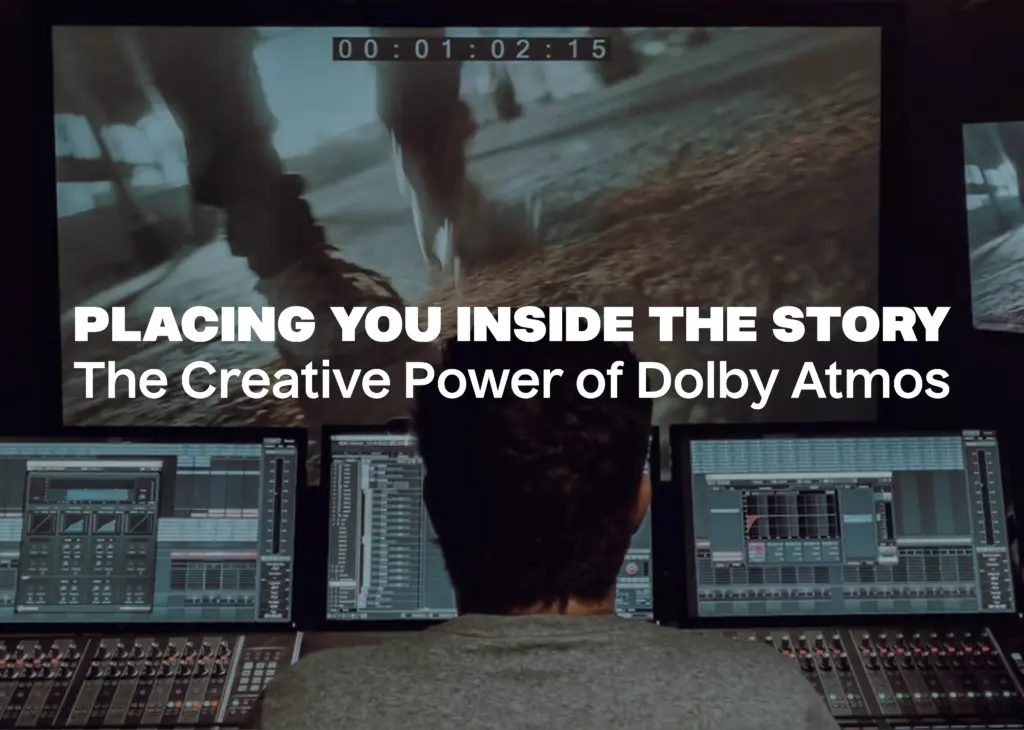
If you’ve ever sat in a cinema and felt a moment move through and you couldn’t quite explain why, there’s a good chance the sound was doing more of the work than you realised. Not just what you were hearing, but where you were hearing it from. This is thanks to Dolby Atmos.
To unpack that a little further, we sat down with Kyle Koekemoer, Head of Audio Post-Production, and Alec Mackay, in-house Score Mixer and technical wizard at Pressure Cooker Studios, to better understand what Dolby Atmos actually is in practice, and what it means for the way we approach audio post-production. Alec also attended a week-long Mix with the Masters seminar hosted by Alan Meyerson last year, bringing back a set of insights that have meaningfully shaped the way we think about and execute score mixing at the studio.
Between Kyle and Alec, they bring both a creative and technical perspective to immersive sound, offering insight into how the format works, where it has the most impact, and how it continues to shape the way audiences experience film, music and beyond.
When we start explaining Dolby Atmos to clients or collaborators, we often begin by grounding it in something familiar. Most people have at least heard of surround sound, even if they are not entirely sure how it works.
As Kyle explains: “That traditional way of working is tied to speakers”.
Sound is assigned to channels, and those channels correspond to physical speaker positions in a room. Dolby Atmos shifts that thinking entirely.
“I like to describe it as a dot in a 3D box. Depending on where the dot is, determines which speaker the sound comes from and how loud it is played through that speaker.”
It is a simple way of describing something quite powerful. Instead of asking which speaker should play a sound, you decide where that sound exists in space, and the system takes care of the rest.
Alec Mackay frames it in a similarly intuitive way, but from a slightly more technical angle: “Instead of traditional surround channels tied to fixed speaker positions, the sound is emitted from imaginary objects placed around and above the listener. Those objects are then re-rendered during playback to best suit the listener’s speaker system, no matter how many speakers they have.” What this unlocks is a kind of flexibility that has not existed in the same way before. The same mix can live comfortably across a wide range of listening environments, from a full cinema installation to a pair of headphones, while still retaining its intent.
There is also a subtle but important addition that tends to be the moment where people lean in a little more. Height. The ability for sound to exist above you, not just around you. “Dolby Atmos is more immersive because it includes a height dimension,” Kyle says. “So, for example, a helicopter flying overhead translates far more accurately than in traditional immersive formats.” It is one of those details that feels obvious once you hear it, because it mirrors how we understand space in real life, yet it fundamentally changes how a scene can be constructed sonically.
From a storytelling perspective, that shift carries real weight. The goal of audio post-production has always been to place an audience inside a world rather than simply letting them observe it. Dolby Atmos strengthens that intention.
“If you can truly place them inside the world, you greatly enhance their overall experience,” Kyle explains.
“You would much rather watch Avengers in 3D than in HD, so why not make the audio experience just as immersive?” It is a useful way of thinking about it, not as an upgrade for the sake of it, but as a tool that brings the audience closer to the emotional core of what they are watching.
There is also a practical elegance to the format that often gets overlooked. In more traditional workflows, different playback formats required different mixes. A film might need to be mixed separately for 7.1, 5.1 and stereo, each one taking time and introducing its own set of compromises. Alec points to how Atmos simplifies that process.
“One of the main advantages of Dolby Atmos is that the same mix can be played back on a stereo system, perhaps a 5.1 home theatre system, and all the way up to a cinema with dozens of speakers. A single workflow and delivery that works for all formats.”
For production teams working across multiple platforms and distribution channels, that kind of consistency becomes incredibly valuable.
Creatively, the impact is perhaps even more tangible. Anyone who has spent time working in stereo understands how quickly things can begin to compete for space. There are only so many places a sound can sit before it starts to feel crowded. “When you are working in stereo, there is only so much you can fit into that two dimensional plane,” Kyle says.
“Dolby Atmos allows us to spread elements out and enlarge the sonic landscape, giving Dialogue, Music, and Sound Effects the space they deserve within the film.”
From the perspective of music, that sense of space becomes something you can actively shape. “Film music needs space to breathe,” Alec explains. “Atmos score mixes allow me to make use of the wider soundstage and channel count, as well as the height factor, to create mixes that come alive in the space around you.”
What that ultimately creates is clarity. A mix where each element has room to exist, where detail is not lost, and where the overall experience feels cohesive rather than congested.
At Pressure Cooker Studios, this way of thinking is built into how we approach audio post-production. Dolby Atmos is not treated as a separate or isolated process, but as part of a broader, integrated workflow that spans both audio and music. “At Pressure Cooker Studios, we offer a full Audio post package, as well as individual Audio and Score Mix deliveries,” Kyle explains.
“I typically handle the Immersive Audio Mixing, while Alec works his magic on the Immersive Music Score Mixes.”
That collaboration between disciplines is essential, because the strength of an immersive mix lies in how those layers interact with one another.
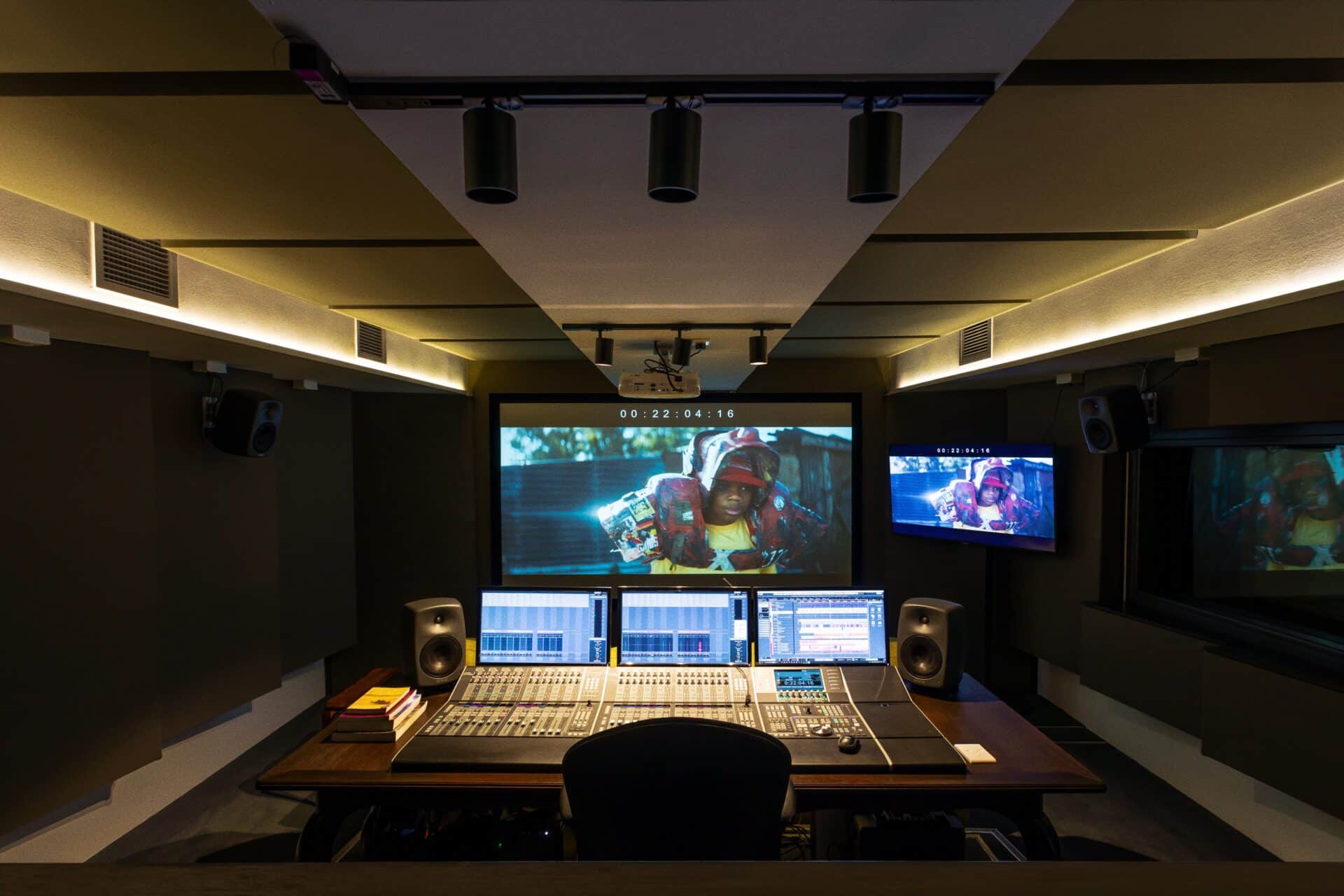
Working in Atmos does, however, require a certain level of restraint. The expanded canvas can be tempting, particularly when it comes to features like height. “I see the height element in particular as a creative tool,” Kyle says. “I use it tastefully to enhance key moments and immerse the audience in a scene. If it is overused, the audience can quickly become fatigued by it.” Like any creative tool, its impact comes from how it is applied, not simply from its presence.
There is also the reality that no two listening environments are the same. A carefully crafted mix might be experienced in a cinema, through a home theatre system, or on a pair of headphones while someone is watching on a laptop. Alec speaks to the importance of anticipating that variability. “We’re regularly testing how a mix folds down into smaller speaker layouts. What does the mix sound like in 7.1 without the ceiling speakers? What does it sound like in stereo with my ‘el-cheapo’ TV speakers? What about binaural playback over earbuds?” The intention is always the same. The mix needs to hold its shape, regardless of where or how it is heard.
When it comes to where Dolby Atmos makes the most impact, there is a natural alignment with narrative work. “There is nothing more immersive than watching a great film in Dolby Atmos at the cinema,” Kyle reflects, and it is difficult to argue with that. At the same time, other areas are beginning to embrace immersive audio in their own ways. Gaming, in particular, presents a compelling space for this kind of thinking. As Alec points out, “Game audio is inherently object based,” which means it shares a conceptual foundation with Atmos, opening up new possibilities for how sound can respond dynamically within a world.
Looking forward, it is clear that immersive audio is becoming part of the broader language of storytelling. The tools are evolving, the platforms are expanding, and audiences are becoming more accustomed to experiencing sound in this way. “The broader Immersive Audio space is constantly growing,” Kyle says. “I am excited to see how the format continues to evolve and improve.”
At Pressure Cooker Studios, that sense of evolution is something we actively lean into. The goal is not simply to keep up with new formats, but to explore what they make possible from a creative point of view. Dolby Atmos represents a shift in how we think about sound, from something that supports the visuals to something that shapes the experience itself. And when it is approached with intention, it has the ability to draw an audience in, not just to what they are seeing, but to what they are feeling within it.
As James Matthes, CEO of Pressure Cooker Studios, puts it: “Dolby Atmos is the standard deliverable now for most cinematic and streaming platforms. It allows us to keep the door open on every level of work that is available to us in the industry.” That standard is not only about format, but about trust. “We’ve invested in the infrastructure, the rooms, the tools, so that when we deliver, we’re not guessing. We know the work is right, because it’s been built and tested in the right environment.”